
AI Agents in BI: The Next Frontier of Decision Intelligence
The world of business intelligence (BI) is changing faster than ever. What started as static dashboards and reports has now evolved into intelligent systems that think, learn, and act.
We’ve entered the era of decision intelligence, and AI agents are leading the charge.
What Are AI Agents in Business Intelligence?
In simple terms, AI agents are digital assistants trained to understand data, interpret business context, and help users make better decisions.
Unlike traditional BI tools that wait for humans to ask questions, AI agents can proactively surface insights, detect anomalies, and even suggest the next best action.
They combine multiple AI capabilities, including natural language processing (NLP), machine learning, and contextual reasoning, to transform how businesses interact with their data.
For example:
- A sales manager can simply ask, “Which region performed best last quarter?”
- A finance analyst can type, “Forecast our Q4 revenue based on current trends.”
And the AI agent instantly generates a report, visualization, or recommendation, all in natural language.
How AI Agents Work in Modern BI Platforms
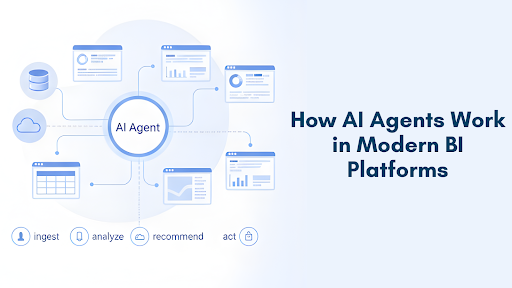
AI agents are not just chatbots; they’re part of a larger decision intelligence framework.
Here’s how they typically operate:
- Data Understanding: They connect to your organization’s data sources from warehouses to live APIs and understand data structures and relationships.
- Contextual Reasoning: Using semantic models (like Microsoft Fabric’s unified model), they understand business terms such as “revenue,” “churn,” or “sales pipeline.”
- Conversational Interface: Users interact with them using natural language instead of SQL or DAX.
- Action Recommendations: Based on insights, AI agents suggest what to do next, like increasing ad spend, rebalancing inventory, or reaching out to specific customers.
- Automation Integration: Some AI agents can trigger actions directly, like updating CRM systems or sending alerts via Teams or email.
Why Are AI Agents Gamechangers?
Traditional BI focuses on what happened.
AI agents focus on what’s next and what to do about it.
Here’s why they matter:
- Conversational Analytics: Anyone in the organization can access insights using plain language; no coding is required.
- Proactive Insights: They identify trends, anomalies, and risks before humans do.
- Speed and Scale: AI agents can process huge datasets and deliver insights instantly.
- Smarter Decisions: They don’t just present data; they connect it to business goals and context.
The Role of Microsoft Fabric and Copilot
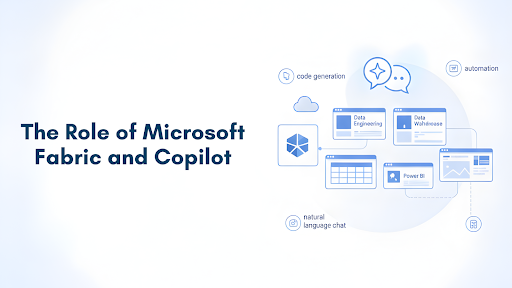
Microsoft Fabric is quickly becoming the home for AI-driven BI.
With Copilot in Power BI, users can:
- Ask natural language questions about their data.
- Generate visuals and reports automatically.
- Summarize dashboards into simple narratives.
- Even create DAX or KQL queries without writing a single line of code.
And with Fabric Data Agents (currently in preview), enterprises can build custom AI agents that blend internal data logic with generative AI, providing real-time, context-aware insights across departments.
This marks the next phase of BI: from self-service analytics to AI-assisted decision-making.
Real-World Applications
1. Sales Forecasting:
AI agents analyze historical trends and automatically generate next-quarter projections.
2. Customer Support Analytics:
Agents summarize customer sentiment from support tickets and recommend action plans for retention.
3. Finance and Compliance:
They flag unusual transactions and automatically draft reports for compliance reviews.
4. Operations and Supply Chain:
Agents detect potential disruptions in real time and alert logistics teams instantly.
The Future of Decision Intelligence
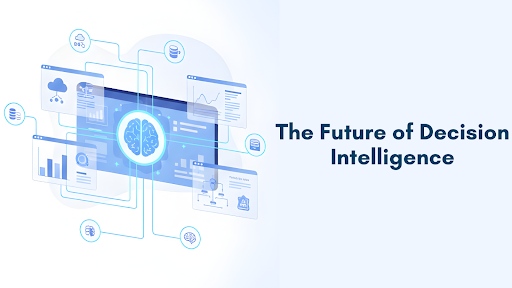
In the coming years, AI agents will move beyond analysis into autonomous decision loops, where insights lead directly to automated actions.
Imagine a BI system that not only identifies a sales dip but also adjusts campaign budgets automatically or notifies the marketing team instantly.
That’s decision intelligence in motion, a seamless blend of human judgment and machine precision.
Conclusion: The Human-AI Partnership
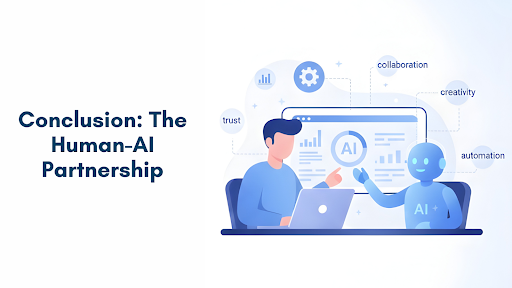
AI agents won’t replace analysts; they’ll empower them.
The future of BI is not about dashboards; it’s about dialogues between humans and data.
And as AI agents continue to evolve, they’ll turn analytics from a reactive tool into a proactive, intelligent partner in every business decision.
FAQs
AI agents are intelligent digital assistants that understand business data, provide insights, detect anomalies, and help users make better decisions using natural language.
AI agents analyze data, understand business context, provide conversational analytics, recommend actions, and automate tasks to support faster decision-making.
Microsoft Fabric enables AI-driven BI through Copilot and Fabric Data Agents, allowing users to generate reports, ask natural language questions, and access context-aware insights.
AI agents deliver proactive insights, conversational analytics, faster data analysis, and actionable recommendations to improve business decisions.
AI agents help organizations move from traditional reporting to AI-assisted decision-making by combining data analysis, business context, and intelligent recommendations.