
Introduction
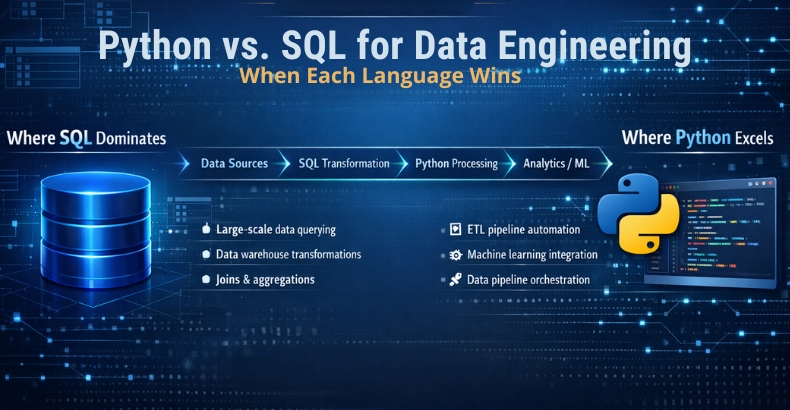
In data engineering, the discussion around Python vs. SQL often sounds like a debate, as if engineers must choose one over the other. In reality, this framing misses the point.
Python and SQL server different purposes in the data ecosystem, and both are essential. SQL forms the backbone of working with structured data in databases and data warehouses. Python, on the other hand, provides flexibility for building pipelines, automating workflows, and integrating data across systems.
The real skill in data engineering is not picking a side but knowing when to use SQL, when to use Python, and how to combine them effectively.
Why SQL Still Rules in Data Engineering
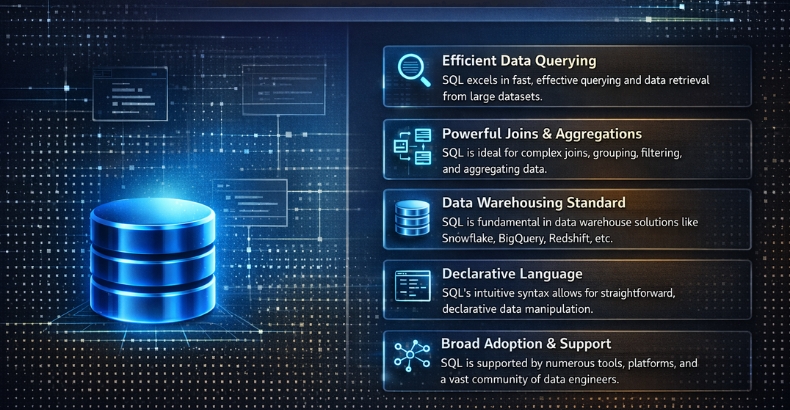
SQL is purpose-built for working with structured data. It is declarative, expressive, and optimized for performance, which is why it remains the industry standard for data access and analytics.
SQL excels at:
- Querying large datasets efficiently
- Filtering, aggregating, and summarizing data
- Joining multiple tables
- Powering analytics, BI tools, and reporting
- Operating at scale inside databases and cloud data warehouses
Because SQL runs directly where the data lives, it avoids unnecessary data movement and leverages highly optimized query engines. In many cases, a well-written SQL query can solve a problem faster, more clearly, and more efficiently than a longer programmatic solution.
For structured data already stored in a database, SQL is often the simplest and most scalable choice.
Why Python Matters in Modern Data Engineering
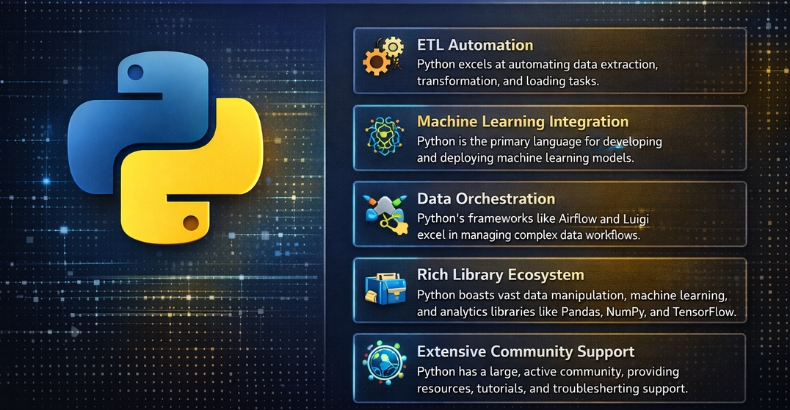
While SQL is unmatched for querying, data engineering rarely stops there. Real-world pipelines involve APIs, files, cloud services, scheduling, and complex transformations, and that’s where Python shines.
Python is widely used for:
- Building ETL and ELT pipelines
- Automating workflows and data movement
- Processing data from APIs, files, and streams
- Handling semi-structured or unstructured data
- Orchestrating jobs with tools like Airflow
- Integrating data engineering with analytics and machine learning
With libraries such as Pandas, PySpark, and Airflow, Python becomes a powerful orchestration and transformation layer. It connects systems, applies business logic, and enables advanced validations that are difficult or impractical to express purely in SQL.
Python also acts as a bridge between data engineering and data science, making it easier to move from raw data to predictive models and intelligent applications.
When Python Wins vs. When SQL Wins
Python wins when:
- You are building or automating data pipelines
- Data comes from APIs, files, or multiple external sources
- Workflow orchestration and scheduling are required
- Complex transformations or validations are needed
- Data is semi-structured or unstructured
SQL wins when:
- Data is already structured and stored in databases
- You need fast joins, aggregations, and filters
- Reporting, BI, and analytics are the primary goals
- Performance and scalability are critical
Understanding these boundaries helps teams avoid overengineering and choose the most efficient tool for each task.
The Real-World Approach: Use Both
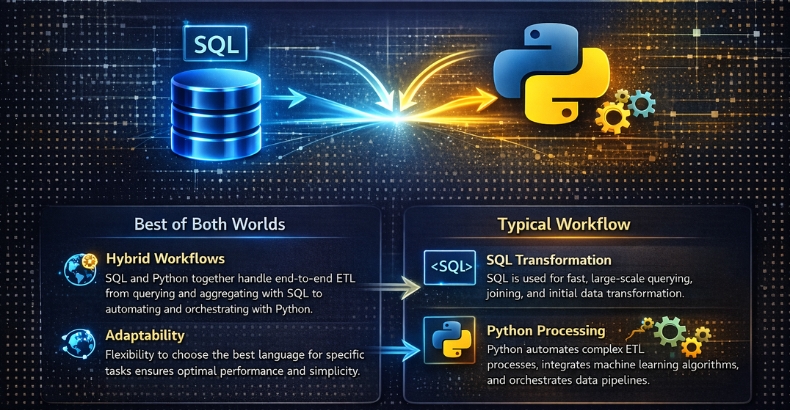
In practice, successful data engineering systems rarely rely on just one language.
A common and effective pattern looks like this:
- Use SQL to extract, join, and aggregate data directly in the database
- Use Python to orchestrate workflows, apply advanced logic, and move data between systems
This hybrid approach keeps transformations close to the data while allowing flexibility at the pipeline level. It results in systems that are faster, more scalable, and easier to maintain.
A Practical Perspective
- SQL helps you talk to data where it lives
- Python helps you shape that data into something useful
One retrieves and summarizes data efficiently. The other automates, integrates, and prepares it for real-world use.
Together, they enable reliable data pipelines that support analytics, machine learning, and business decision-making.
Conclusion
Python vs. SQL is not a competition; it’s a collaboration.
SQL remains the backbone of structured data processing, while Python adds flexibility, automation, and intelligence to modern data workflows. Data engineers who understand when each language wins can design better pipelines, reduce complexity, and deliver real business value.
In today’s data-driven organizations, mastering both and knowing how to use them together is what separates good data engineering from great data engineering.