
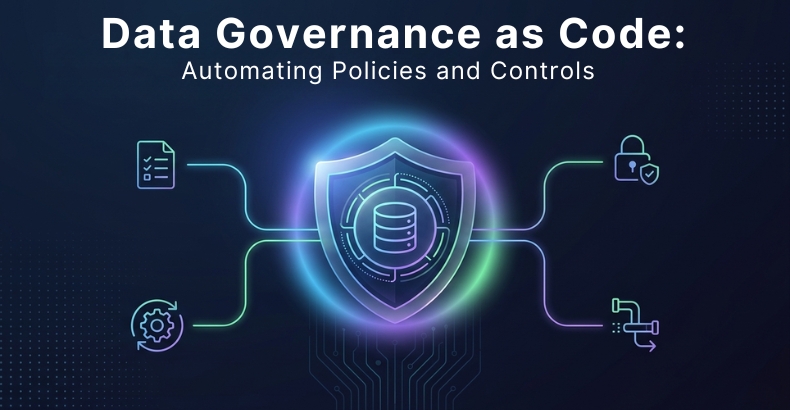
Why Governance Must Move from Documents to Systems
Most organizations believe they have data governance in place.
There are policies defined, compliance frameworks documented, and access rules clearly written. On paper, everything looks structured.
But in reality, governance often breaks at execution.
Access controls are applied inconsistently. Data quality rules are not enforced uniformly. Compliance checks happen after issues arise, not before.
The problem isn’t the absence of governance.
The problem is that governance is not built into the system itself.
The Shift: From Guidelines to Execution
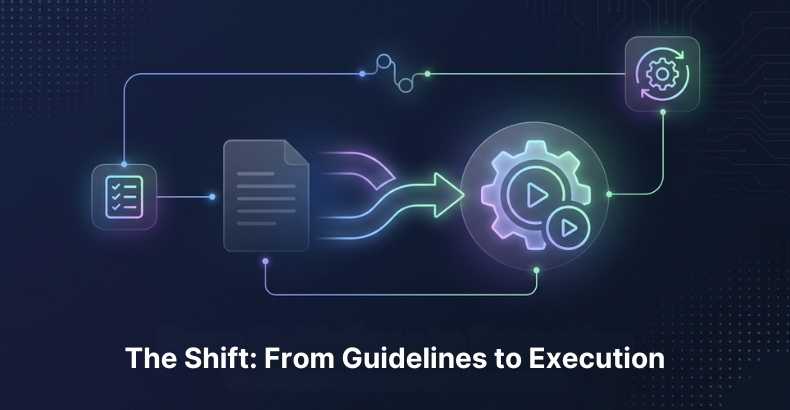
Traditional governance operates like a checklist.
Modern data environments don’t.
As data ecosystems become more complex with multiple pipelines, cloud platforms, and real-time processing, manual governance simply cannot keep up.
This is where Data Governance as Code changes the approach entirely.
It transforms governance from something you manage manually into something that runs automatically.
What “As Code” Really Means
When we say, “as code,” we’re not just talking about automation; we’re talking about embedding rules into the architecture.
Instead of relying on people to follow policies, systems enforce them by design.
Access is controlled programmatically.
- Data quality rules run during ingestion.
- Compliance checks happen continuously.
- Changes are version-controlled and traceable.
Governance becomes part of the workflow, not a separate layer.
Why This Matters Now
The urgency for this shift is not theoretical; it’s practical.
Organizations today face:
- Rapidly increasing data volumes are making data management more complex and challenging.
- Strict regulatory requirements require stronger data governance and compliance practices.
- Distributed teams working across platforms need seamless access and better collaboration.
- Real-time decision-making needs faster and more accurate data insights.
In this environment, governance cannot depend on manual oversight. It needs to be automated, consistent, and scalable.
Where Organizations Start Seeing Value
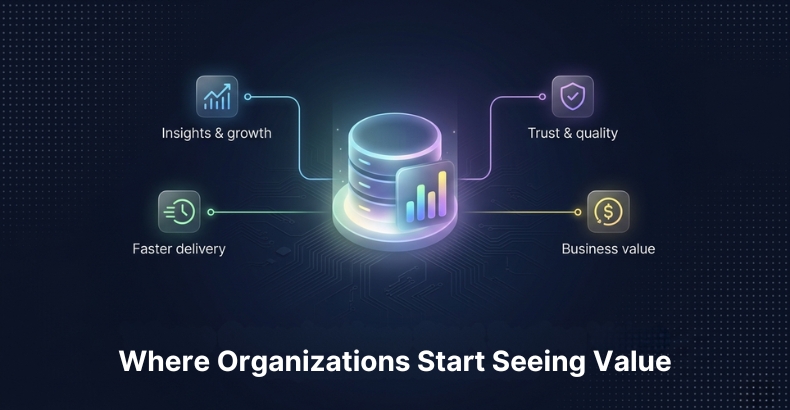
The impact of data governance as code is not just technical; it’s operational.
It brings clarity and control across the data lifecycle:
- Policies are applied consistently across all environments.
- Errors are caught early, not after reporting.
- Compliance becomes proactive instead of reactive
- Teams spend less time managing rules and more time using data.
Over time, governance shifts from being a bottleneck to becoming an enabler of speed and trust.
The Real Advantage: Trust at Scale
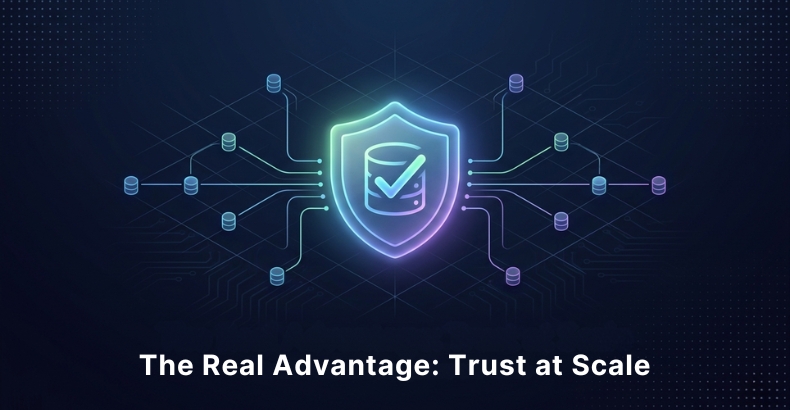
At its core, this approach solves one of the biggest challenges in modern data systems: trust.
When governance is automated:
- Data becomes more reliable, delivering consistent, accurate insights you can truly trust.
- Access becomes more secure, ensuring your information is protected with strong control and governance.
- Decisions become more confident, powered by clear insights and real-time data visibility.
And most importantly, trust doesn’t depend on individuals; it depends on systems.
What It Requires
Adopting Data Governance as Code is not just a technical upgrade; it’s a mindset shift.
Organizations need:
- Clearly defined governance rules
- Alignment between data, engineering, and security teams
- Infrastructure that supports automation and monitoring
- A culture that treats governance as a core function, not a formality
Conclusion
Data Governance as Code represents a fundamental shift in how organizations control and trust their data.
It moves governance from static documents to living systems where policies are not just defined but automatically enforced.
In a world where data complexity is growing faster than ever, the organizations that succeed will not be the ones with the most rules but the ones that can apply those rules consistently, automatically, and at scale.
FAQs
Data Governance as Code is an approach that embeds governance rules directly into data systems, allowing policies to be enforced automatically through workflows and automation.
Moving governance into systems ensures policies are applied consistently, compliance is automated, and governance becomes part of everyday data operations.
Data governance as code improves policy enforcement, detects errors earlier, supports proactive compliance, and builds greater trust in organisational data.
Automated governance helps organisations manage growing data volumes, meet regulatory requirements, support distributed teams, and enable reliable real-time decision-making.
Organisations need clearly defined governance rules, collaboration between data and security teams, automation-ready infrastructure, and a governance-focused culture.