
Introduction
AI is changing the way businesses work with data. Instead of opening multiple dashboards or writing complex queries, users can simply ask questions and receive answers in natural language.
But one important question remains: Can users access only the data they are authorized to see?
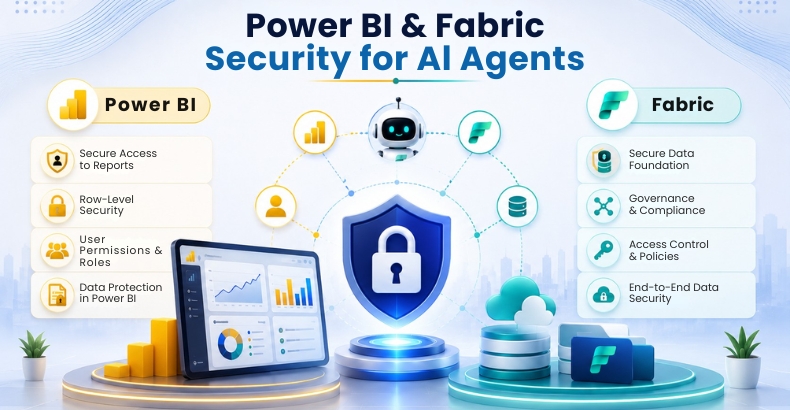
As AI agents become part of modern analytics, security and governance are just as important as the AI itself. Power BI and Microsoft Fabric offer different ways to bring AI into data workflows while keeping access, security, and governance in focus.
Why Security Matters for AI Data Agents
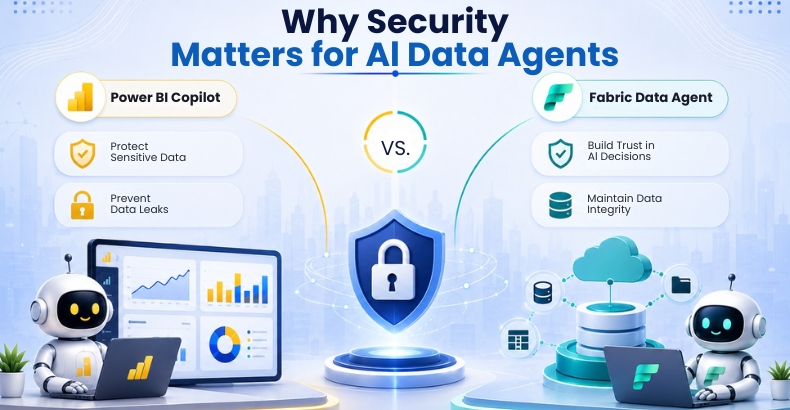
AI makes data easier to access, but that convenience also creates responsibility. A user might ask an agent about sales, customers, financial performance, or operations.
The system must understand what information that user is authorized to access.
Good AI data security should include:
- Proper user authentication and permissions
- Clear data ownership
- Strong governance policies
- Appropriate access controls
- Monitoring and auditing
The goal is simple: make data easier to use without making sensitive data easier to access.
What Is Power BI Copilot?
Power BI Copilot brings AI directly into the Power BI experience. It helps users understand reports and semantic models through natural-language questions.
For example, instead of manually checking several charts, a user could ask the following:
“Which region had the biggest drop in sales this quarter?”
Copilot can help summarize and explain the information available within the Power BI environment.
For companies already using Power BI, this provides a familiar way to introduce AI into everyday business analytics.
What Is a Fabric Data Agent?
Fabric Data Agent provides a conversational way to work with data within the Microsoft Fabric environment.
Users can ask questions about connected data without needing to understand complex tables or query languages.
For example:
“Which products generated the highest revenue last month?”
This makes data exploration easier, especially for business users who need answers but may not have advanced technical skills.
Power BI Copilot vs. Fabric Data Agent
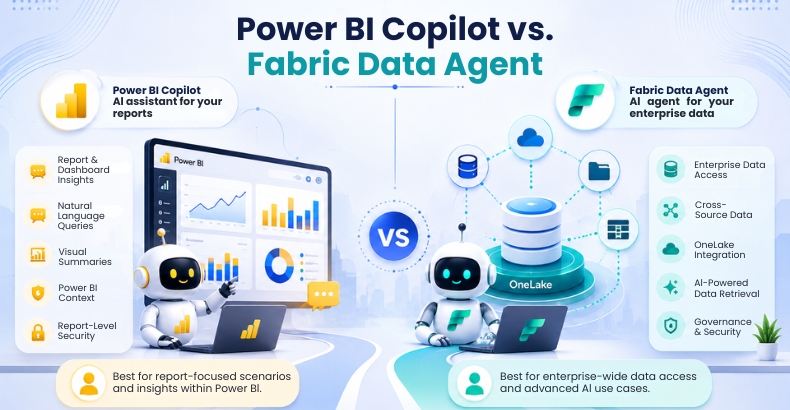
The two solutions have different strengths.
Power BI Copilot is closely connected to Power BI reports, semantic models, and traditional BI workflows. It is a natural choice for organizations that already depend heavily on Power BI for reporting and decision-making.
Fabric Data Agent fits more broadly into the Microsoft Fabric ecosystem and is useful when organizations want conversational access to Fabric data assets.
So, the decision is not really about which tool is “better.” It depends on where your data lives and how your teams use it.
Security Should Come First
AI should never operate outside an organization’s existing security framework.
For Power BI and Fabric environments, organizations should pay attention to the following:
Identity and Access: Users should only receive access to the information they are authorized to view.
Data Governance: Data should have clear ownership, classification, and documentation.
Least-Privilege Access: Users and AI systems should receive only the permissions they actually need.
Monitoring: Organizations should track data access and investigate unusual activity when necessary.
These controls help create a safer environment for AI-powered analytics.
How to Choose the Right Approach
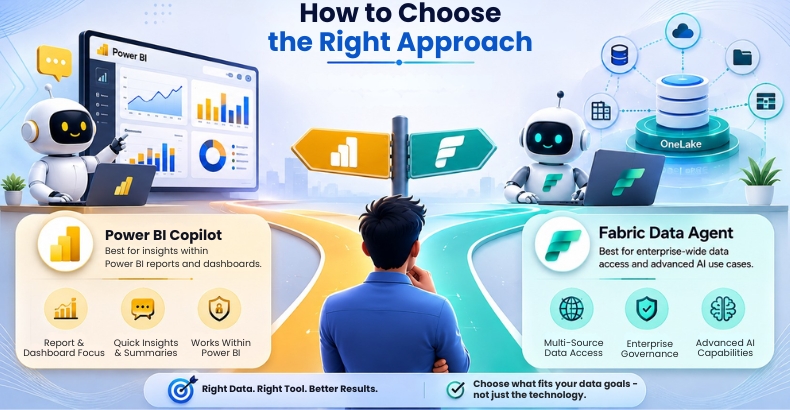
Start by looking at your current analytics environment.
If your teams mainly work with Power BI reports and semantic models, Power BI Copilot may be the more natural option.
If you want users to interact conversationally with a wider range of Microsoft Fabric data, Fabric Data Agent may be a better fit.
In some organizations, both solutions can have a place within the overall analytics strategy.
Building a Strong Foundation
Before introducing AI agents, organizations should make sure their data foundation is reliable.
That means having:
- Trusted and high-quality data
- Clear ownership and governance
- Well-defined access policies
- Secure semantic models and data assets
- Proper monitoring and auditing
When these fundamentals are in place, AI can deliver useful insights without compromising control.
The Future of AI-Powered Analytics
Business intelligence is moving beyond static dashboards. People increasingly want to ask questions in plain language and receive useful answers immediately.
Power BI and Microsoft Fabric are helping make this possible.
But the real value of AI-powered analytics is not simply getting faster answers. It is getting trusted answers from the right data, for the right person, with the right level of access.
Conclusion
Power BI Copilot and Fabric Data Agent are helping organizations move toward more conversational and intelligent analytics.
Power BI Copilot works closely with the Power BI experience, while Fabric Data Agent supports conversational interaction across the broader Fabric environment.
As AI becomes a bigger part of business intelligence, organizations should focus on more than what an agent can do. They should also ask:
“Who can access the data behind the answer?”
With strong security, governance, and trusted data, businesses can make analytics simpler and faster while keeping their most important information protected.
FAQs
Power BI Copilot uses AI to help users analyze reports and data through natural language questions.
A Fabric Data Agent allows users to ask questions and interact with data conversationally within the Microsoft Fabric environment.
Security controls help ensure that AI agents can only access data that users are authorized to view.
Power BI Copilot focuses on Power BI reports and semantic models, while Fabric Data Agent supports conversational access to a broader range of Fabric data assets.
Businesses can use strong access controls, least-privilege permissions, data governance, monitoring, and regular security reviews.