
Introduction
For years, accessing business data required SQL knowledge, technical skills, and support from data teams. In 2026, that is changing.
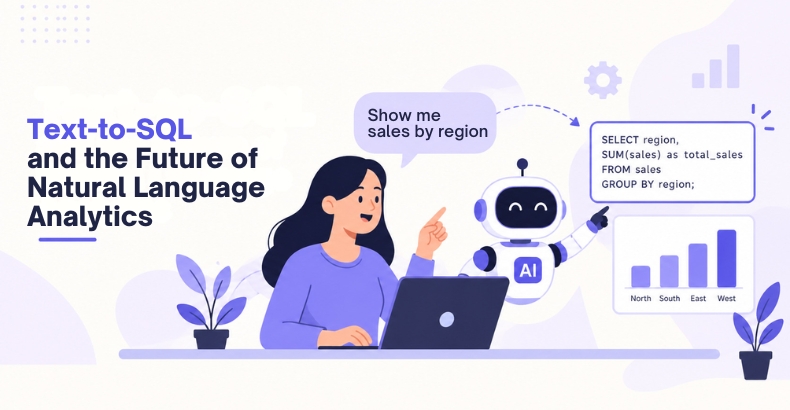
Users increasingly want to ask questions in plain language and receive useful answers without understanding databases or writing complex queries. Text-to-SQL helps make this possible by converting natural-language questions into SQL queries that retrieve information from business data.
This shift is making analytics more accessible and changing how people work with data.
From SQL Queries to Simple Questions
Imagine a sales manager asks the following:
“Which product generated the highest revenue last quarter?”
Traditionally, answering this question could require SQL knowledge, database expertise, and help from an analyst.
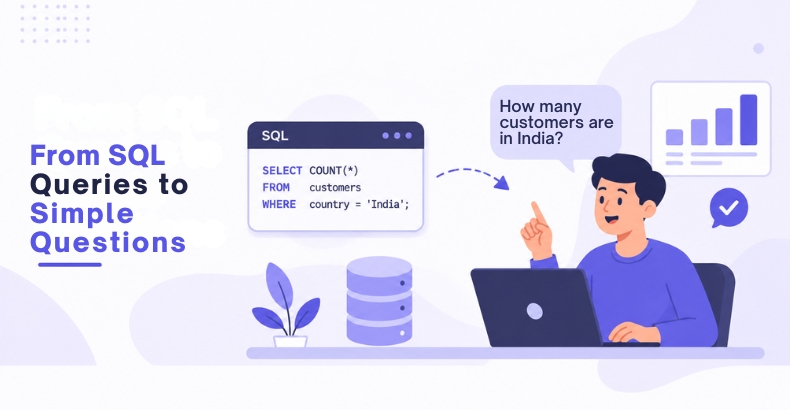
With Text-to-SQL, the user can simply ask the question. An AI system interprets the request, identifies relevant data, creates the SQL query, and returns the result.
The goal is not to replace SQL. It is to create a simpler way for people to interact with existing data.
How Text-to-SQL Works
Text-to-SQL connects a user’s question with an organization’s data and an AI model.
The process generally includes:
Understand the question:
The AI identifies what the user wants to know.
Understand the data:
The system examines tables, columns, relationships, and business definitions.
Generate the query:
The AI converts the request into SQL.
Execute and validate:
The query runs against the appropriate data source and is checked for potential issues.
Present the answer:
The result can be shown as text, a table, or a visualization.
Every step matters because a technically correct query can still produce a misleading answer if the wrong data or definition is used.
Why Natural Language Analytics Matters
The biggest advantage of Text-to-SQL is accessibility.
Not every employee needs to become an SQL expert to use business data. Marketing teams can explore campaign results, finance teams can review financial trends, and operations teams can investigate performance using everyday language.
This reduces the gap between business questions and data insights.
It can also help analysts save time. Instead of repeatedly creating simple queries and reports, they can focus on deeper analysis, data modeling, and strategic work.
Where Text-to-SQL Can Add Value
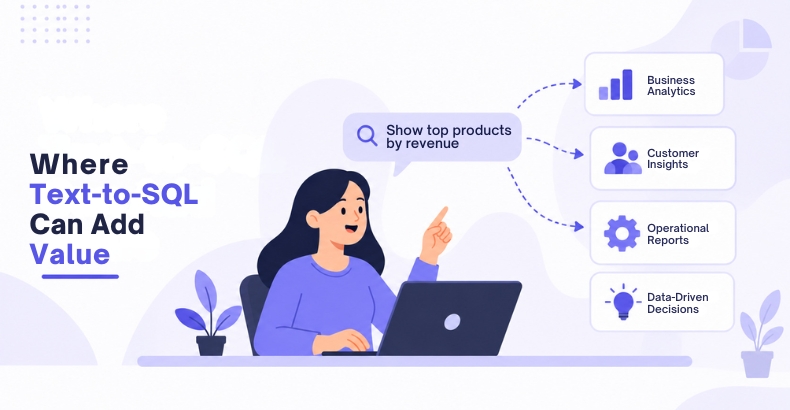
Text-to-SQL can support many everyday business questions.
Sales:
“Which regions missed their monthly targets?”
Finance:
“How did operating expenses change compared with last year?”
Manufacturing:
“Which production line had the most downtime this month?”
Customer Analytics:
“Which customer segment has the highest repeat purchase rate?”
These questions may sound simple, but answering them can require information from multiple tables and systems. Text-to-SQL can make this process faster and easier.
The Biggest Challenge: Understanding Business Context
Text-to-SQL is powerful, but it is not automatically accurate.
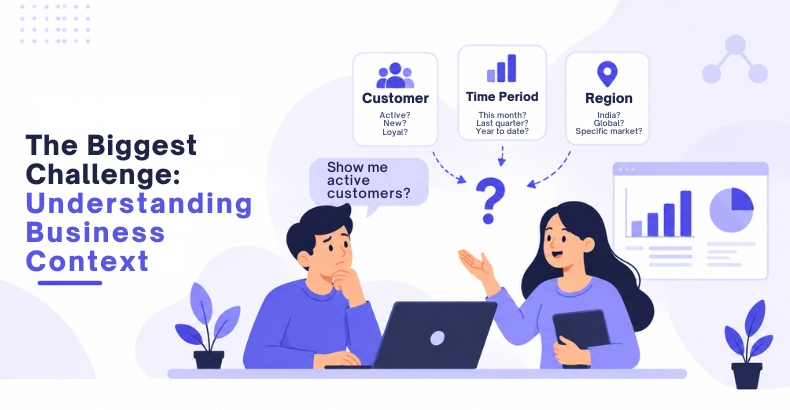
AI can generate a technically valid query that produces the wrong business answer.
For example, different departments may define “revenue” differently. One team might include discounts, while another might exclude them. If the AI does not understand the correct definition, the result may look accurate while being misleading.
Successful text-to-SQL requires more than a capable AI model.
Organizations should establish:
- Trusted data sources
- Clear business definitions
- Strong metadata
- Reliable semantic models
- Query validation
- Human oversight for important decisions
The objective is not simply to generate SQL. It is to generate SQL that correctly reflects the business context.
Security and Governance Still Matter
Making data easier to access does not mean giving everyone access to everything.
Text-to-SQL systems should respect existing security policies and user permissions. Employees should only retrieve information they are authorized to see.
This becomes especially important when queries involve customer information, financial records, employee data, or other sensitive information.
Organizations should also monitor data access, protect underlying sources, and maintain clear governance policies.
Natural-language analytics should improve accessibility without weakening security.
The Future of Natural Language Analytics
Text-to-SQL is likely to become part of a broader conversational analytics experience.
Instead of asking one question and starting over, users could continue a conversation:
“Why did sales decline?”
Then:
“Which region contributed most to the decline?”
And:
“What changed in that region?”
The system can maintain context and help users explore a business problem step by step.
This could turn traditional dashboards into interactive analytical environments where users investigate data through conversation rather than navigating multiple reports.
What Organizations Should Do Now
Businesses planning to adopt Text-to-SQL should start with their data foundation.
A practical approach includes:
- Identify trusted data sources.
- Define important business terms.
- Improve metadata and documentation.
- Establish access controls.
- Test real business questions.
- Validate results before important decisions.
Starting with focused use cases helps organizations understand where natural-language analytics can create real value.
Conclusion
Text-to-SQL is changing how people interact with business data. By translating natural-language questions into SQL queries, it reduces technical barriers and makes self-service analytics more practical.
However, successful adoption depends on more than AI. Data quality, governance, security, and business context remain essential.
The goal is not to replace data professionals. It is to help more people ask better questions, explore information faster, and make informed decisions.
The future of analytics may not begin with writing a query. It may begin with simply asking the right question.
FAQs
Text-to-SQL uses AI to convert natural-language questions into SQL queries that retrieve data from databases.
It allows users to ask questions in plain language without needing advanced SQL or database knowledge.
Yes. AI may generate a technically valid query that does not match the intended business definition or context.
Yes, when properly implemented with user permissions, access controls, data governance, and monitoring.
Text-to-SQL is expected to support more conversational analytics, allowing users to explore business data through natural-language conversations.