
In 2026, businesses face unprecedented challenges: rapid market shifts, evolving customer expectations, and global uncertainties. Growth, risk management, and timely decision-making remain universal goals, but the reality is clear: no one can see the future.
That’s where predictive analytics becomes a strategic advantage. By leveraging historical data, advanced algorithms, and AI-driven insights, organizations can anticipate trends, mitigate risks, and plan with confidence. Instead of reacting to problems, they prepare for them. Instead of guessing, they forecast outcomes with evidence.
What Is Predictive Analytics?
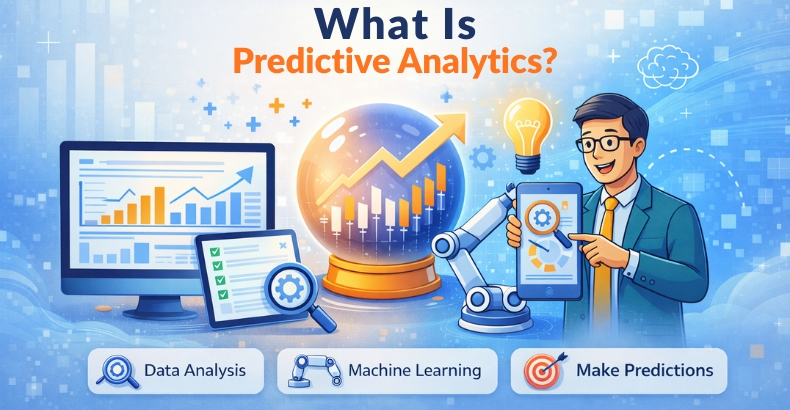
Predictive analytics is the practice of using historical data, statistical models, and machine learning to forecast future outcomes. It helps answer critical business questions such as
- Which customers are likely to churn?
- When will sales peak or decline?
- Where could operational risks emerge?
- What products or services will be in demand next?
It doesn’t promise certainty, but it provides direction grounded in data, enabling leaders to act proactively.
Why Businesses Use Predictive Analytics in 2026
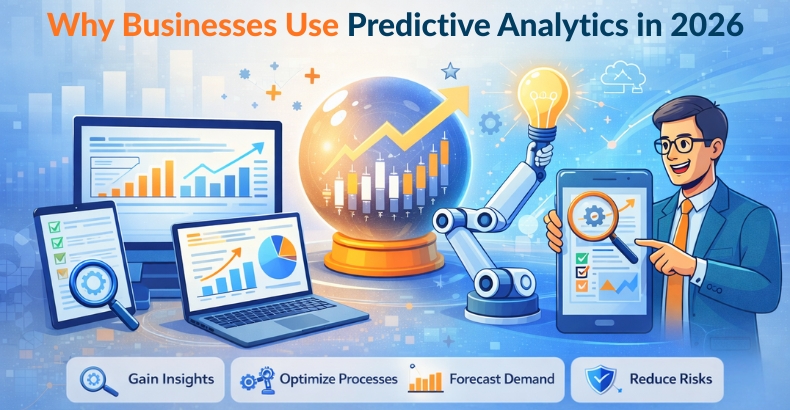
A strong business strategy is no longer about today; it’s about being ready for tomorrow. Predictive analytics empowers organizations to:
- Understand customer behavior with precision.
- Reduce unexpected risks by identifying early warning signals.
- Plan inventory and resources more effectively.
- Enhance marketing performance through targeted campaigns.
- Discover new growth opportunities in emerging markets.
With early insights, leaders make smarter, faster, and more confident decisions.
A Simple Analogy
Running a business without predictive analytics is like driving while only looking in the rearview mirror; you know where you’ve been, but not where you’re going.
Predictive analytics is the windshield. You may not control the road, but you can see what’s ahead and adjust. That visibility, even partial, makes all the difference in navigating uncertainty.
Real Business Use Cases
In 2026, predictive analytics is embedded across industries:
- Sales Forecasting: Anticipating demand cycles to optimize revenue.
- Customer Churn Prediction: Identifying at-risk customers before they leave.
- Fraud Detection: Spotting anomalies in financial transactions.
- Inventory Management: Balancing supply chains with predictive demand planning.
- Marketing Optimization: Personalizing campaigns for higher ROI.
These applications transform forecasts into actionable outcomes, bridging the gap between planning and execution.
Conclusion
Predictive analytics turns data into foresight and foresight into strategy. Businesses that embrace predictive insights don’t just react to change; they prepare for it. They reduce uncertainty, strengthen planning, and stay ahead of competitors.
In 2026’s fast-moving world, success doesn’t come from guessing right. It comes from preparing smart, acting early, and leveraging data as a strategic asset.
FAQs
Predictive analytics uses historical data, statistical models, and machine learning to forecast future outcomes and support proactive business decision-making.
Predictive analytics helps businesses anticipate trends, reduce risks, improve planning, and make faster, data-driven decisions in a rapidly changing business environment.
Predictive analytics helps organizations understand customer behavior, optimize resources, improve marketing performance, and identify new growth opportunities.
Predictive analytics is used for sales forecasting, customer churn prediction, fraud detection, inventory management, and marketing optimization.
Predictive analytics provides data-driven forecasts that help organizations prepare for future challenges, reduce uncertainty, and make more informed strategic decisions.