
Introduction
Microsoft Fabric has quickly become one of the most talked-about unified analytics platforms, bringing together data engineering, data warehousing, real-time analytics, Power BI, and AI capabilities into a single ecosystem. By eliminating fragmented tools and centralizing data management through OneLake, Fabric promises faster insights, better collaboration, and lower operational complexity.
However, adopting Microsoft Fabric is not simply a technology upgrade. It requires changes in architecture, governance, processes, and skills. While many organizations recognize Fabric’s potential, they often encounter challenges that slow adoption and reduce the expected return on investment.
Understanding these challenges early allows businesses to build a smoother migration strategy and maximize the value of their Fabric investment.
Why Fabric Adoption Is Growing
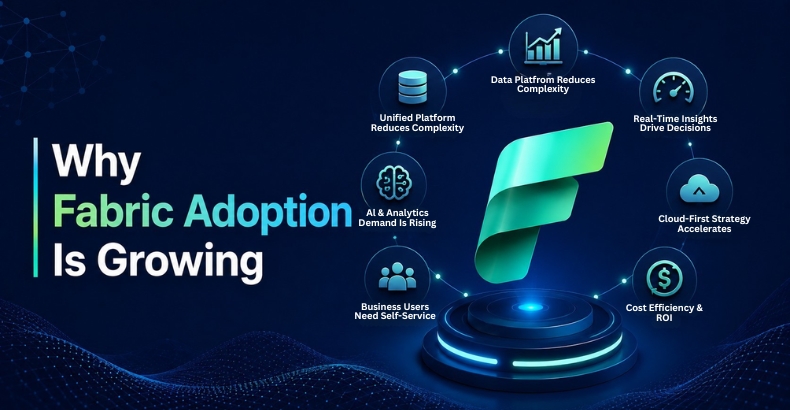
Organizations are increasingly adopting Microsoft Fabric because it simplifies modern analytics. Instead of managing multiple disconnected platforms, teams can work within one integrated environment.
Fabric enables businesses to:
- Unify data across departments
- Improve collaboration between engineering and analytics teams
- Support AI-driven insights
- Reduce infrastructure complexity
- Deliver faster business intelligence
Despite these advantages, successful adoption requires careful planning.
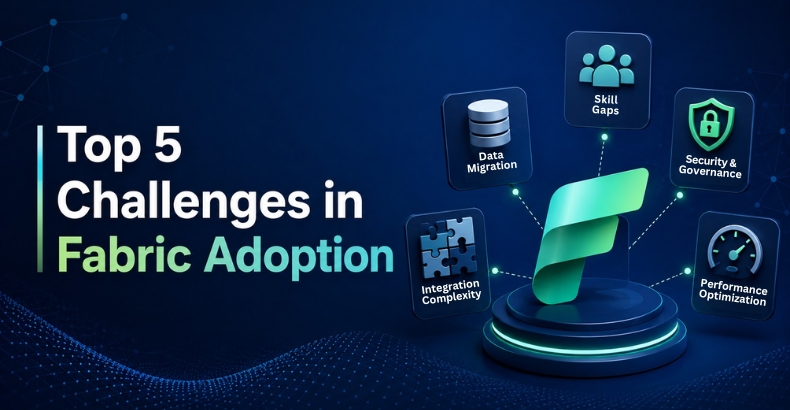
Challenge 1: Migrating Legacy Data Environments
Many organizations already operate mature data warehouses, ETL pipelines, and reporting systems built over several years.
Migrating these environments into Microsoft Fabric can be challenging because existing architectures often include custom integrations, complex business logic, and multiple data sources.
Without a structured migration roadmap, organizations may experience data inconsistencies, performance issues, or unexpected downtime.
A phased migration approach, beginning with high-value workloads, helps reduce risk while allowing teams to gain experience with the new platform.
Challenge 2: Data Governance and Security
Bringing data into a unified platform improves accessibility, but it also increases the importance of governance.
Organizations must establish clear policies for:
- Data ownership
- Role-based access
- Data quality
- Security controls
- Regulatory compliance
Features such as OneLake Security, sensitivity labels, and centralized governance help strengthen security, but they require proper planning and ongoing management.
Strong governance ensures that users can access trusted data without compromising security or compliance.
Challenge 3: Skills and Change Management
Technology alone does not guarantee successful adoption.
Many organizations face a learning curve as teams transition from traditional analytics tools to Microsoft Fabric. Data engineers, analysts, and business users all need to understand new workflows, capabilities, and best practices.
Common challenges include:
- Limited fabric expertise
- Resistance to process changes
- Slow user adoption
- Inadequate training
Investing in training and encouraging collaboration across technical and business teams significantly improves adoption success.
Challenge 4: Performance and Cost Optimization
Although Microsoft Fabric simplifies analytics, organizations still need to manage resources efficiently.
Poorly designed pipelines, unnecessary data duplication, or oversized workloads can increase operational expenses and reduce performance.
To optimize the platform, organizations should focus on:
- Incremental data processing
- Efficient data models
- Workload monitoring
- Capacity planning
- Regular performance reviews
Building cost awareness from the beginning helps organizations scale confidently while controlling expenses.
Challenge 5: Building a Modern Data Culture
One of the biggest adoption challenges is cultural rather than technical.
Many organizations continue to rely on spreadsheets, isolated reports, and department-specific data practices. Even with Fabric in place, users may hesitate to trust centralized analytics if old habits remain.
Successful organizations promote a data-driven culture by encouraging collaboration, standardizing KPIs, improving data literacy, and making trusted data easily accessible across the business.
When people embrace the platform, its business value increases dramatically.
Best Practices for Successful Fabric Adoption
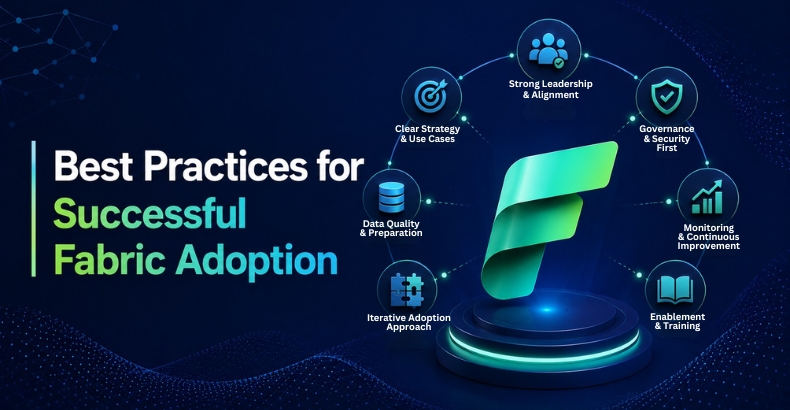
Organizations can improve adoption by following a structured implementation strategy:
- Start with clear business objectives instead of technology alone.
- Prioritize high-impact use cases that deliver measurable value.
- Establish governance before scaling workloads.
- Train both technical teams and business users.
- Monitor performance, costs, and user adoption regularly.
A gradual rollout often delivers better long-term results than attempting a large-scale migration all at once.
Conclusion
Microsoft Fabric is transforming how organizations manage analytics by providing a unified platform for data integration, engineering, governance, business intelligence, and AI.
However, successful adoption requires more than deploying new technology. Organizations must address migration planning, governance, skill development, performance optimization, and cultural change to realize Fabric’s full potential.
Businesses that approach adoption strategically will reduce implementation risks, improve collaboration, and accelerate data-driven decision-making.
As Microsoft Fabric continues to evolve throughout 2026, organizations that invest in strong foundations today will be better positioned to scale analytics, embrace AI, and build a future-ready data ecosystem.
FAQs
The main challenges include legacy migration, data governance, skills gaps, cost optimization, and change management.
Migration can be challenging when organizations have complex legacy systems, pipelines, and integrations.
Businesses can start with high-value use cases, provide training, establish governance, and use a phased migration strategy.
Fabric provides capabilities for access control, security, sensitivity labeling, and centralized data governance.
Organizations can control costs through capacity planning, workload monitoring, efficient data processing, and regular performance reviews.