

Stop Wasting Time on Trends: Your 3-Step Plan to Guaranteed Data ROI
We all know the drill: every few months there’s a new AI tool, a new analytics platform, or a new “game-changing” technology everyone rushes to adopt. But here’s the reality: successful businesses don’t win by chasing trends. They win by solving real problems that create measurable business value.
A strong data strategy is not about collecting dashboards, tools, or certifications. It’s about creating outcomes that improve decisions, save time, reduce costs, and increase revenue. The companies seeing real ROI from data are the ones focusing less on hype and more on execution.
Want sustainable ROI from your data initiatives? Stop selling projects and start solving business problems.
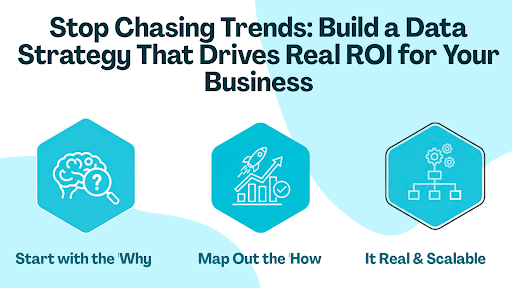
Here is your focused, practical framework to build a data strategy that actually works:
1. The Real Starting Point: The ‘Why’
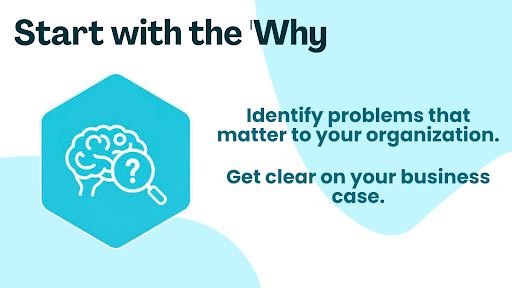
Before discussing AI models, dashboards, or cloud platforms, define the business problem first.
Too many organizations start with technology and then search for a use case later. That approach almost always leads to wasted budgets and low adoption.
Solve the Big Problem
Identify the issue that unlocks the highest business value.
Ask questions like:
- Where are we losing money?
- What process wastes the most time?
- Which business challenge impacts customers the most?
Maybe it’s reducing customer churn, improving sales forecasting, optimizing inventory, or eliminating manual reporting delays. Your biggest pain point should become your biggest data priority.
Show the Money
Every data initiative should connect to a measurable outcome.
If a project cannot clearly improve efficiency, revenue, customer experience, or cost savings, it becomes difficult to justify long-term investment. Clear KPIs create alignment, secure executive buy-in and help teams stay focused on impact instead of activity.
The goal isn’t to “be data driven.”
The goal is to drive better business results using data.
2. The Smart Plan: The ‘How’
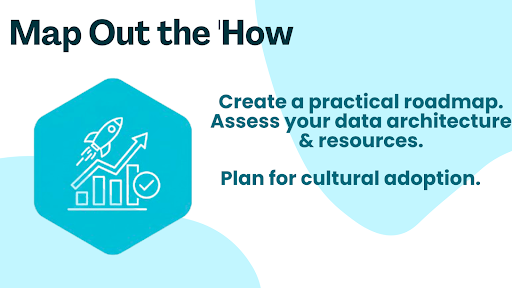
Once the ‘why’ is clear, the next step is building a realistic and scalable execution plan.
A successful data journey is never built overnight. It’s built through small, strategic improvements that compound over time.
The roadmap
Forget the giant multi-year transformation plans that never leave the PowerPoint stage.
Start with:
- Quick wins
- High-impact use cases
- Simple automation opportunities
Then gradually strengthen your data ecosystem while expanding into larger initiatives. Momentum matters more than perfection in the early stages.
The Foundation
Even the best AI strategy fails without a solid data foundation.
Take an honest look at:
- Your data quality
- Existing architecture
- Reporting systems
- Governance processes
- Team capabilities
Bad data creates bad decisions. Strong foundations create scalable growth.
The People Factor
Technology alone doesn’t create transformation; people do.
One of the biggest reasons data projects fail is because employees never adopt the solution. Teams continue using spreadsheets, manual workflows, or gut instinct because they don’t trust or understand the system.
That’s why change management matters just as much as implementation.
Train people. Simplify adoption. Build trust in the insights.
A dashboard nobody uses has zero ROI.
3. The Path to Scale: Make It Real
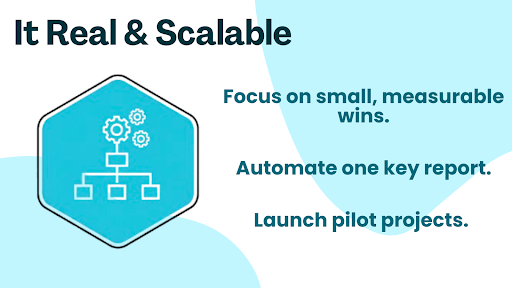
Many businesses wait years expecting a “perfect” transformation before showing results. That delay kills momentum, confidence, and support.
Instead, focus on delivering value early and consistently.
Small Wins, Big Impact
Start with smaller projects that can show measurable improvement within months, not years.
Quick wins create confidence across leadership teams and prove that your strategy is working. Early success builds momentum for bigger investments later.
Automate the Pain
Find repetitive manual tasks that consume hours every week.
Maybe it’s
- Weekly Excel reporting
- Manual KPI tracking
- Inventory reconciliation
- Data consolidation from multiple systems
Automating even one painful process can immediately save time, reduce errors, and improve productivity across teams.
Sometimes the fastest ROI comes from solving the simplest operational frustrations.
Test Before You Commit
Not every idea deserves a full-scale rollout immediately.
Use pilot projects to:
- Validate assumptions
- Test data quality
- Measure adoption
- Improve governance
- Identify risks early
FAQs
Businesses can improve data ROI by focusing on solving real business problems, defining measurable goals, and aligning every data initiative with business outcomes.
Starting with the ‘why’ helps identify the most valuable business challenges, ensuring data projects address real needs instead of adopting technology without a clear purpose.
A successful data strategy includes defining business goals, building a strong data foundation, encouraging user adoption, and delivering value through scalable improvements.
User adoption is essential because even the best dashboards and analytics solutions deliver little value if employees do not use or trust them.
Organizations can scale data initiatives by delivering quick wins, automating repetitive processes, testing ideas through pilot projects, and expanding successful solutions over time.