
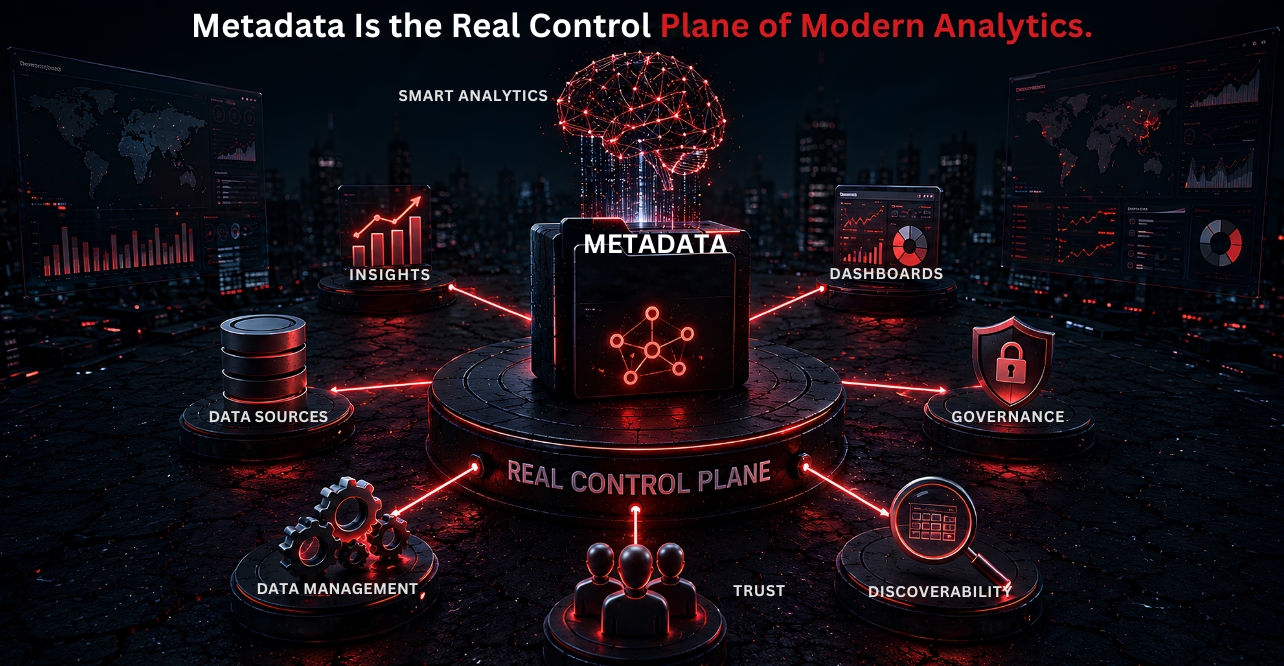
Why Data Alone Is No Longer Enough
In today’s digital economy, data is often treated as the most valuable business asset. Organizations invest heavily in cloud platforms, data warehouses, AI tools, dashboards, and analytics pipelines, all with one common belief: more data leads to better decisions.
At first glance, that assumption seems logical. If companies can collect enough customer data, operational insights, and business intelligence, they should naturally become faster, smarter, and more efficient. But in reality, raw data alone rarely creates clarity.
Data can power reports, dashboards, and predictive models, but it does not automatically create trust, visibility, or consistency. As modern analytics ecosystems grow more distributed and complex, organizations are realizing that the real challenge is not collecting data; it is controlling it.
This is where metadata becomes critical.
Often overlooked as technical documentation, metadata is now becoming one of the most important layers in modern analytics. It provides the context, structure, ownership, and intelligence needed to make data reliable and scalable. That is why many forward-thinking organizations now treat metadata as the real control plane of modern analytics.
Why Metadata Matters More Than Ever
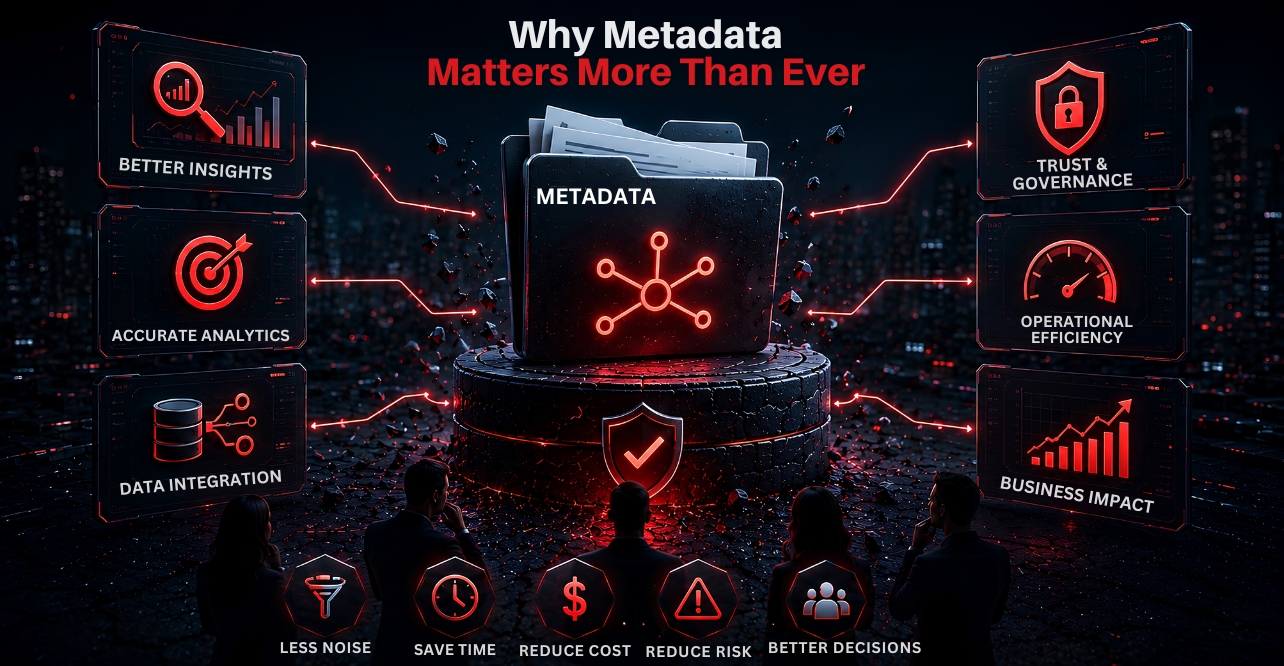
Think of metadata as the intelligence behind data. While data shows values, records, and events, metadata explains what that data means, where it came from, how it moves, who owns it, and whether it can be trusted.
Without this context, organizations may still store massive amounts of information, but decision-making becomes slower and riskier. Teams may not know whether a dataset is current, whether it has been duplicated, or whether it is approved for reporting or AI use.
In smaller systems, this visibility can sometimes be managed manually. Data teams may track ownership, lineage, and quality using spreadsheets or isolated governance tools. But modern analytics no longer operates in simple environments.
Today, businesses manage the following:
- Cloud-based data warehouses
- Real-time pipelines
- Distributed engineering teams
- AI and machine learning workflows
- Cross-platform reporting systems
As complexity grows, manual tracking quickly breaks down. This is why metadata is no longer optional support; it is becoming critical operational infrastructure.
More Than Just “Data About Data”
Metadata is frequently referred to as data about data, but this definition only provides a superficial understanding. In modern analytics, metadata acts as the connective layer that links trust, governance, ownership, observability, and automation.
Its real value lies in making systems understandable and manageable. Without metadata, organizations often operate in fragmented ecosystems where duplication increases, governance weakens, and trust becomes inconsistent.
For example, metadata helps answer questions that directly impact business decisions:
- Where did this dataset originate?
- Who owns this data and who is responsible for maintaining it?
- Is this data approved for reporting, compliance, or AI usage?
These are not technical questions anymore; they are business-critical questions.
As organizations scale, metadata shifts from passive information to an active framework for operational control.
Why Metadata Becomes the Control Plane
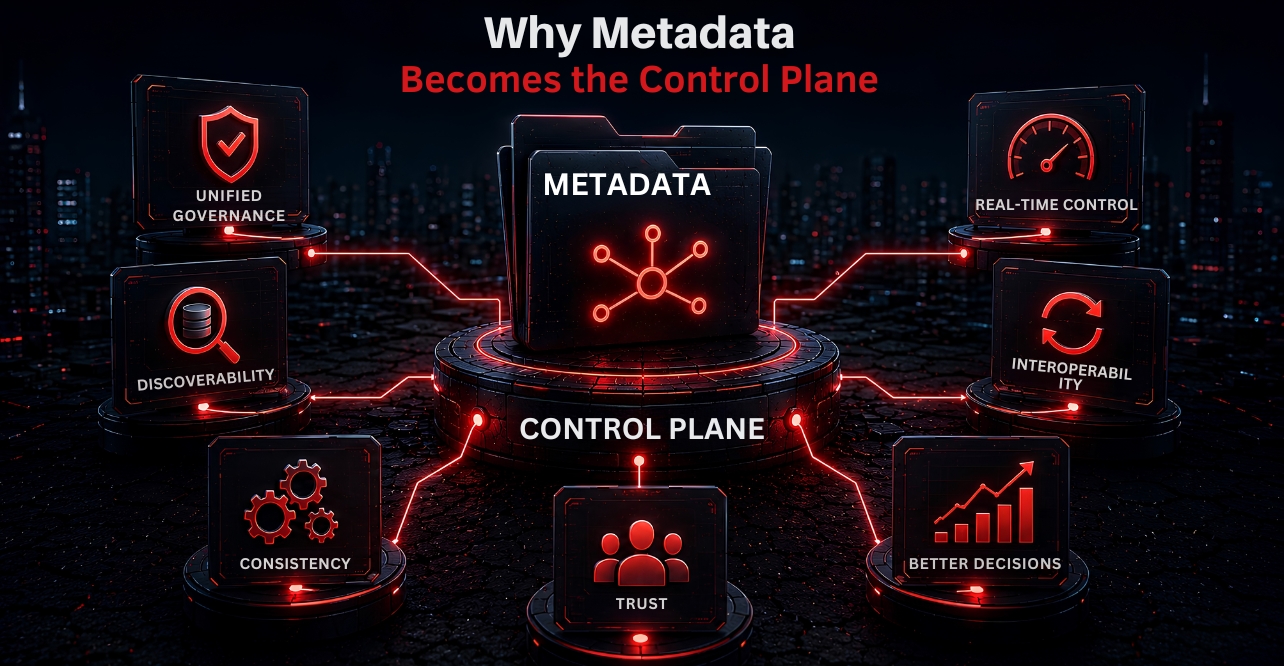
In technology, a control plane is the layer that governs how systems behave. It provides visibility, management, and consistency across complex environments. In modern analytics, metadata increasingly plays this exact role.
It allows organizations to move beyond simply collecting and processing data. Instead, metadata helps control how data behaves across pipelines, dashboards, machine learning models, governance workflows, and business applications.
This shift is powerful because metadata creates alignment between technical operations and business trust. When strong metadata systems are in place, organizations can trace lineage, understand dependencies, and identify risks before they impact reports or decisions.
With strong metadata, businesses can:
- Improve governance and policy enforcement
- Strengthen lineage visibility across systems
- Reduce duplication and inconsistency
- Support automation in data quality and AI workflows
The Risk of Ignoring Metadata
Many organizations heavily invest in cloud infrastructure, analytics platforms, AI tools, and dashboards but underestimate metadata strategy. Such neglect often creates hidden operational complexity.
At first, the problem may seem small. A duplicate dataset appears. A report shows inconsistent results. An AI model uses outdated information. But as systems grow, these issues multiply.
Without strong metadata, businesses commonly face the following:
- Poor visibility into data lineage
- Duplicate datasets across teams
- Weak governance due to unclear ownership
- Low trust in analytics outputs
- Higher operational friction in AI and reporting workflows
In some cases, teams spend more time validating data than actually using it.
At that point, the issue is not missing data; it is missing control.
Metadata and the Future of Automation
One of the biggest reasons metadata is becoming more strategic is automation. As organizations adopt AI, DataOps, real-time analytics, and intelligent workflows, metadata becomes essential for making automation trustworthy.
Metadata helps automation work intelligently by enabling:
- Automated lineage tracking
- Policy enforcement
- Data quality validation
- Security visibility
- AI model trust and explainability
This is why metadata is becoming deeply connected to modern data governance and observability.
What Smart Organizations Are Doing Differently
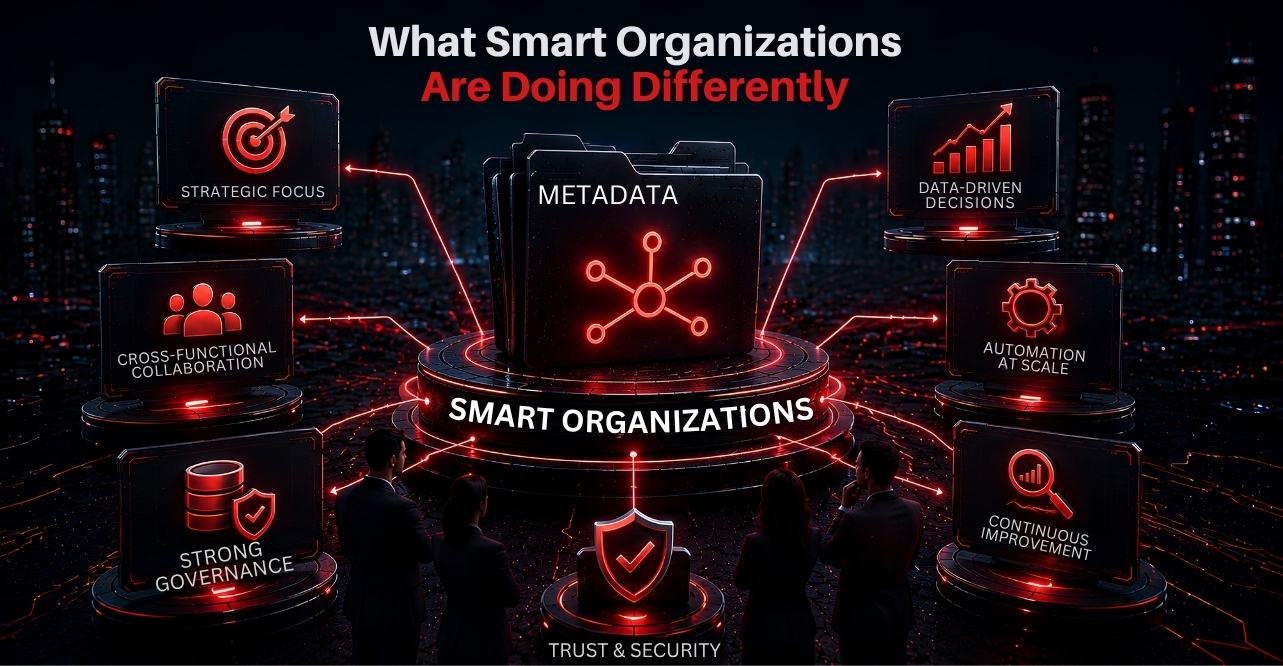
Forward-thinking organizations no longer treat metadata as a technical side process. They treat it as a strategic asset that supports trust, visibility, and scale.
Instead of reacting after data issues appear, they are embedding metadata into the entire analytics lifecycle.
A few common shifts include:
- Building stronger data catalogs and lineage visibility
- Automating governance and quality controls through metadata
- Connecting metadata with observability, security, and AI systems
This approach allows businesses to scale analytics with confidence while reducing operational friction.
Conclusion
Modern analytics is no longer just about collecting, storing, or processing data. It is about managing trust, reducing complexity, and building systems that scale intelligently.
That is why metadata is the real control plane of modern analytics. It provides the ownership, visibility, and context needed to make data reliable across increasingly complex ecosystems.
Because in modern analytics, data may power decisions.
But metadata is what keeps the entire system in control.
FAQs
Data alone does not provide trust, consistency, or visibility. Organizations also need metadata to understand, govern, and manage data effectively across complex analytics environments.
Metadata provides context about data, including its meaning, source, ownership, movement, and usage, helping organizations manage and trust their data.
Metadata acts as the control layer by improving governance, data lineage, policy enforcement, automation, and visibility across analytics systems.
Without strong metadata, organizations may face duplicate datasets, weak governance, poor data lineage, inconsistent reporting, and reduced trust in analytics.
Metadata enables automation by supporting data lineage tracking, policy enforcement, data quality validation, security visibility, and trusted AI workflows.