
Why Keeping More Data Isn’t Always the Smartest Decision
In today’s data-driven world, organizations collect enormous amounts of information every day. Customer interactions, financial records, operational data, application logs, and analytics datasets continue to grow across multiple systems.
Many businesses follow a simple approach: keep everything.
At first, this approach seems beneficial because historical data supports reporting, analytics, and decision-making. However, data is not only an asset; it is also a responsibility. The longer information is stored, the greater the storage costs, security risks, and compliance obligations become.
This is why data retention has become an important business strategy. Organizations must balance the value of data with the risks and responsibilities associated with retaining it.
Why Data Retention Matters More Than Ever

Cloud storage has made it easier and more affordable to store data, but effortless storage does not mean data should be kept forever.
Every retained dataset creates potential risks. Sensitive customer information, outdated files, duplicate records, and unused data can increase exposure if a security incident occurs.
At the same time, privacy regulations continue to become stricter. Businesses must answer important questions such as the following:
- How long should data be stored?
- Which data continues to provide business value?
- Which records are legally required?
- When should data be archived or deleted?
Without clear policies, organizations often retain information indefinitely, leading to higher costs and increased complexity.
The Three Factors of Data Retention
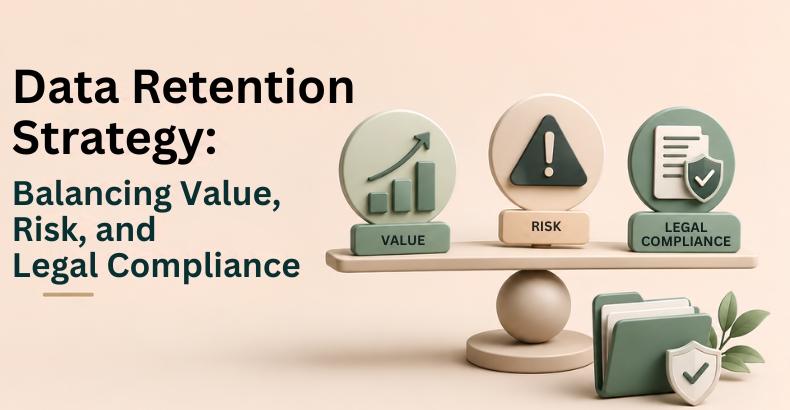
An effective retention strategy balances value, risk, and compliance.
The Value of Data
Data creates value when it supports decision-making, forecasting, customer insights, and operational improvements. Historical information can reveal trends and help organizations improve business performance.
However, not all information remains useful forever. Some datasets continue to provide value for years, while others become outdated quickly.
The goal is not to keep all data but to retain the right data.
The Risk of Keeping Too Much Data
Many organizations focus on collecting data but rarely consider deleting it.
The more information a company stores, the greater its security exposure becomes. A data breach can also expose unnecessary information.
Common risks include:
- Increased security exposure
- Higher storage costs
- More complex governance
- Difficulty identifying trusted data
- Greater legal and compliance risks
In many situations, retaining unnecessary data creates more risk than business value.
The Compliance Factor
Regulations often determine how long information must be retained.
Financial records, healthcare data, employee information, and customer records frequently have specific retention requirements. Privacy regulations also require organizations to delete personal information when it is no longer needed.
Compliance is not only about retaining data; it is also about removing data at the appropriate time.
Why “Keep Everything” Is No Longer a Strategy

For many years, organizations believed that storage was inexpensive, so retaining everything seemed reasonable.
Today, this approach creates significant challenges.
As data volumes continue to grow, organizations face higher costs, increased complexity, and greater compliance requirements. Teams often spend more time managing outdated information than using data to create value.
Successful organizations understand that effective retention means maximizing value while minimizing risk.
Building an Effective Data Retention Strategy
A strong retention strategy requires collaboration between business, legal, security, and data teams.
Several important practices include:
Define Data Categories
Information should be classified according to its sensitivity, business value, and regulatory requirements.
Establish Retention Policies
Every data category should have a clearly defined retention period.
Automate Lifecycle Management
Automation helps enforce retention policies consistently and reduces manual effort.
Archive Before Deletion
Some information may still need to be preserved for legal or historical reasons. Archiving reduces risk while maintaining accessibility.
Review Policies Regularly
Business needs and regulations change over time, so retention policies should be reviewed periodically.
The Role of Technology
Modern platforms provide tools that simplify retention management.
Organizations increasingly use the following:
- Data classification tools
- Metadata management
- Automated retention policies
- Archiving solutions
- Governance platforms
Artificial intelligence is also helping organizations identify outdated or low-value information that can be archived or removed.
What Smart Organizations Are Doing Differently

Leading organizations no longer treat data retention as only a compliance requirement. Instead, they view it as a strategic practice that improves governance, security, and operational efficiency.
These organizations focus on retaining data that delivers business value, reducing unnecessary storage costs, automating retention policies, and aligning data lifecycles with legal requirements.
By managing data proactively rather than storing everything indefinitely, they reduce risk, improve compliance, and build greater trust in their information systems.
Conclusion
A successful data retention strategy is about balancing value, risk, and compliance.
Organizations that retain everything often increase costs, complexity, and security exposure. Those that manage data strategically gain stronger governance, improved compliance, lower risk, and more trustworthy analytics.
Because success is not determined by how much data you keep.
It is determined by how effectively you manage the entire data lifecycle.
FAQs
A data retention strategy defines how long different types of data should be stored, archived, or deleted based on business value, risk, and compliance requirements.
Storing all data increases storage costs, security risks, governance complexity, and compliance obligations without always providing long-term business value.
An effective strategy balances data value, security risk, and regulatory compliance to ensure information is retained only as long as necessary.
Organizations can classify data, establish retention policies, automate lifecycle management, archive important records, and regularly review retention practices.
A well-managed data retention strategy improves governance, reduces security risks, supports regulatory compliance, lowers storage costs, and increases trust in business data.