
Introduction
Modern businesses operate in an environment where change is constant. New technologies emerge rapidly, customer expectations evolve, and organizations continuously look for better ways to use data for decision-making. However, many analytics environments were built for stability rather than adaptability.
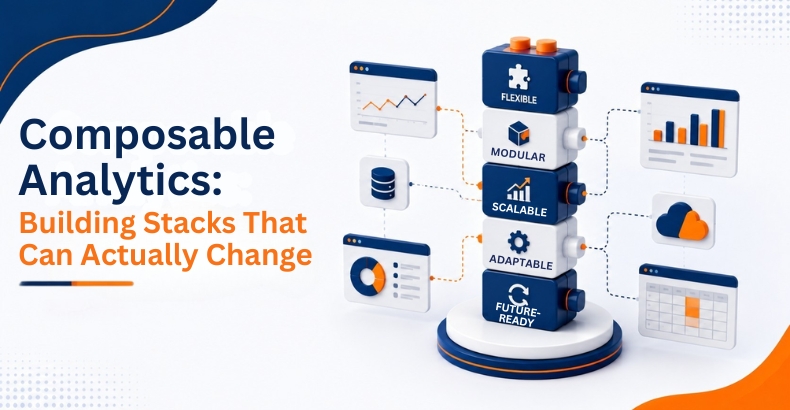
This challenge has led to the rise of Composable Analytics, a modern approach that focuses on flexibility, modularity, and scalability. Instead of relying on a single platform to manage every aspect of analytics, organizations build ecosystems using independent components that work together seamlessly.
This approach allows businesses to evolve their analytics capabilities without rebuilding entire systems whenever requirements change.
What Is Composable Analytics?
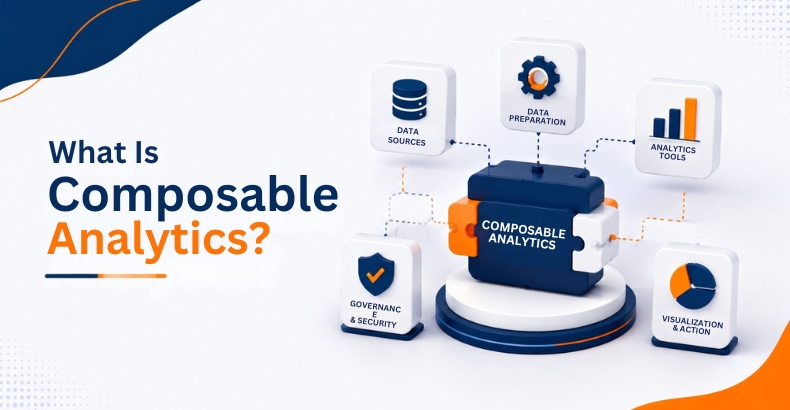
Composable Analytics is an architectural approach that enables organizations to build analytics solutions using modular and reusable components. Rather than depending on one tightly integrated platform, businesses combine specialized tools for data ingestion, storage, transformation, governance, analytics, and reporting.
Think of it like building with LEGO blocks. Each component serves a specific purpose and can be added, replaced, or upgraded without affecting the entire structure.
As businesses adopt cloud platforms, AI-driven analytics, and real-time processing, this flexibility becomes increasingly valuable.
Why Traditional Analytics Stacks Struggle
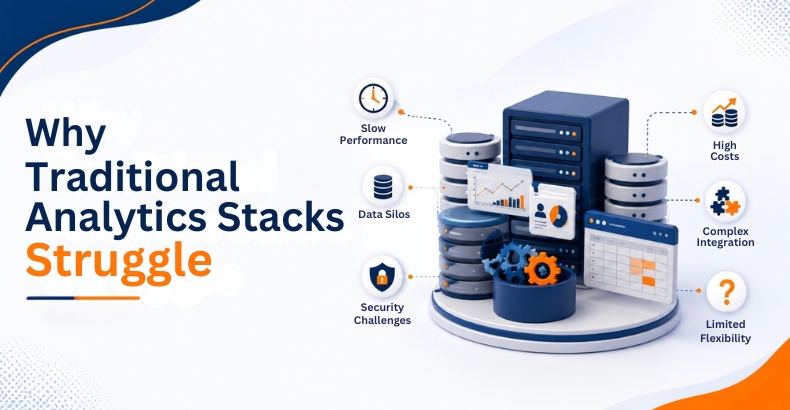
Many traditional analytics environments were designed when data ecosystems were much simpler. Organizations relied on centralized warehouses, fixed reporting systems, and limited data sources.
Today, businesses face challenges such as the following:
- Difficulty integrating modern cloud and AI services
- Vendor lock-in that limit’s flexibility
- High maintenance costs
- Slow implementation of new capabilities
As business requirements evolve, these limitations reduce agility and make it difficult to respond quickly to market changes.
The Core Principles of Composable Analytics
Composable analytics is built on several important principles.
Modularity
Each component performs a specific function. Data ingestion, storage, transformation, and reporting operate independently, allowing organizations to upgrade individual services without disrupting the entire environment.
Interoperability
Modern platforms use APIs, open standards, and shared data models to allow different technologies to work together. This gives organizations the freedom to choose the best tools for their needs.
Reusability
Pipelines, semantic models, governance rules, and data products can be shared across teams. This reduces duplication and improves consistency.
Scalability
Organizations can scale individual services independently instead of expanding the entire infrastructure, improving both flexibility and cost efficiency.
How Composable Analytics Works in Practice
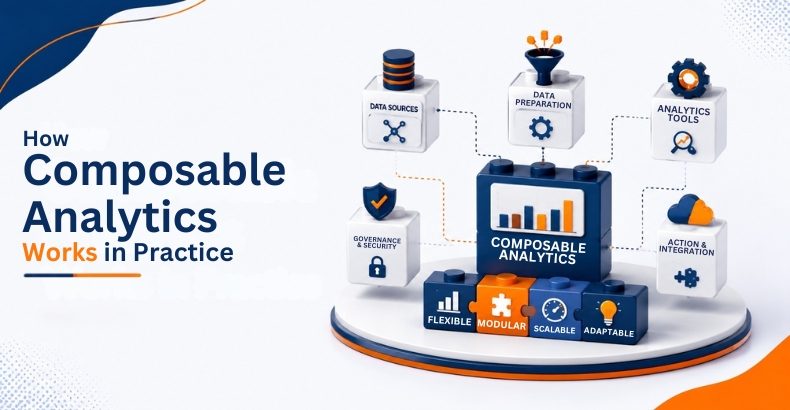
A composable analytics stack combines multiple technologies within a unified architecture.
For example, a company may use cloud storage for data management, a Lakehouse for analytics processing, governance tools for security, and Power BI for reporting.
Because these components remain loosely connected, organizations can replace or upgrade individual services as technology evolves. This creates a future-ready environment that adapts to changing requirements while maintaining performance and governance.
The Business Benefits
The benefits of composable analytics extend beyond technology and directly impact business performance.
Organizations often experience:
- Faster implementation of new analytics capabilities
- Greater flexibility when requirements change
- Reduced dependence on a single vendor
- Better cost management through independent scaling
- Improved collaboration between teams
Perhaps the biggest advantage is continuous innovation. Instead of waiting for major system upgrades, organizations can introduce new capabilities gradually as business needs evolve.
Real-World Example
Consider a retail company that initially built its analytics environment around a traditional data warehouse. As the business grows, it wants to introduce AI-driven forecasting, customer analytics, and real-time inventory monitoring.
In a traditional environment, these changes might require expensive migrations and major architectural changes.
With a composable approach, the company can add new services while keeping existing reporting systems intact. AI tools, streaming platforms, and visualization technologies can be integrated without disrupting core operations. This approach reduces risk, accelerates innovation, and supports long-term growth.
Conclusion
Composable Analytics represents a major shift in modern analytics architecture. Rather than building rigid systems that become difficult to change, organizations can create flexible ecosystems that evolve alongside technology and business needs.
By combining modular components, open integration standards, and scalable services, businesses gain the agility needed to compete in a rapidly changing environment.
The future of analytics will not belong to organizations with the largest technology stacks. It will belong to those with the most adaptable ones.
Because in a world where change is constant, the ability to evolve becomes the greatest competitive advantage.
FAQs
Composable Analytics is a modular approach that combines independent analytics components to build flexible and scalable data solutions.
It helps organizations adapt quickly to changing business needs without rebuilding their entire analytics environment.
The key principles are modularity, interoperability, reusability, and scalability.
It improves flexibility, reduces vendor dependency, supports independent scaling, and speeds up innovation.
It allows organizations to add or upgrade analytics services without disrupting existing systems, supporting long-term growth.