
Introduction
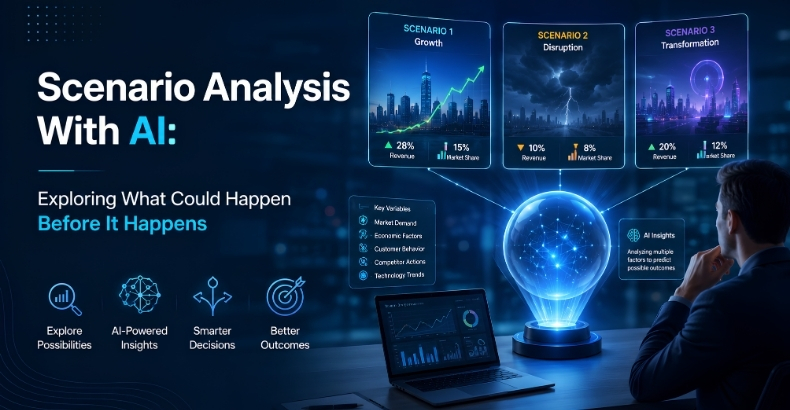
In 2026, businesses face constant change. Customer demand shifts quickly, supply chains remain unpredictable, AI is transforming workflows, and market conditions can change faster than traditional planning cycles.
This raises an important question: “What if?”
What if demand falls? What if costs increase? What if a key supplier fails? What if new technology changes customer expectations?
Traditional forecasting often focuses on one expected outcome. AI-powered scenario analysis helps businesses explore multiple possibilities before making important decisions.
What Is AI-Powered Scenario Analysis?
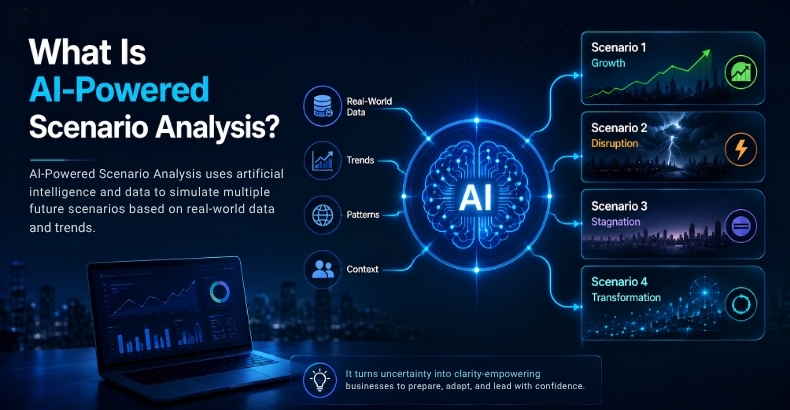
AI-powered scenario analysis combines historical data, real-time information, machine learning, and business assumptions to explore potential outcomes.
Instead of asking, “What will happen?” organizations can ask, “What could happen if conditions change?”
For example, a company can evaluate how revenue may change if demand increases, production costs rise, or a competitor changes its pricing.
Think of it as a flight simulator for business. Teams can test different strategies in a virtual environment before committing real resources.
The goal is not to predict the future perfectly. It is to understand possible outcomes and prepare better responses.
Why Traditional Forecasting Falls Short
Traditional forecasting relies heavily on historical trends. While useful, it becomes less reliable when business conditions change quickly.
Customer preferences can shift, supply chains can face disruptions, and economic conditions can change with little warning. At the same time, AI and emerging technologies are reshaping industries faster than traditional planning models can adapt.
A single forecast therefore provides only one view of the future.
AI-driven scenario analysis offers a broader approach. Businesses can compare different conditions and understand how they may affect revenue, costs, operations, and customer behavior.
This helps decision-makers prepare for both expected and unexpected situations.
How AI Scenario Modeling Works
AI scenario modeling combines information from sales, customer behavior, finance, operations, market trends, and external business signals.
AI models analyze this information to identify patterns, relationships, and potential risks. Teams can then adjust important variables such as the following:
- Demand and pricing
- Production costs
- Inventory levels
- Staffing requirements
- Supplier availability
- Marketing investment
The system evaluates how these changes could influence business performance.
Because modern AI can work with continuously updated data, scenario models can adapt as conditions change. This makes planning more dynamic and reduces dependence on fixed forecasts.
Real-World Applications Across Industries
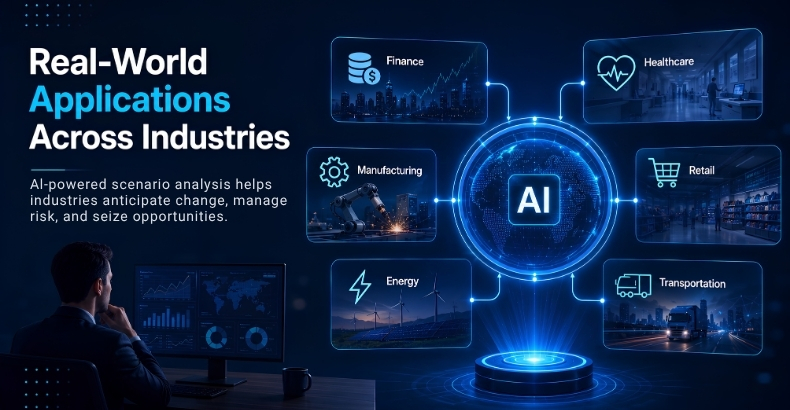
AI-powered scenario analysis can support decision-making across many industries.
Retail and E-commerce
Retailers can test how pricing changes, promotions, demand fluctuations, or supply shortages could affect sales and inventory.
Finance
Financial teams can model the potential impact of interest rates, market volatility, operating costs, and economic changes on business performance.
Manufacturing and Supply Chain
Manufacturers can simulate supplier failures, transportation delays, production bottlenecks, and raw material cost increases to prepare contingency plans.
Healthcare
Healthcare organizations can explore different patient demand, staffing, and resource allocation scenarios to improve operational planning.
Technology and SaaS
Technology companies can evaluate customer growth, subscription trends, cloud costs, and product adoption before making major investments.
The Business Value of AI-Powered What-If Analysis
The biggest advantage of AI scenario analysis is better decision-making under uncertainty.
By comparing multiple outcomes, leaders gain a clearer view of risks, opportunities, and trade-offs.
For example, a manufacturer planning to increase production can test different demand scenarios before investing in additional capacity. This can help avoid both underproduction and unnecessary spending.
Scenario analysis also improves collaboration. Finance, operations, sales, and leadership teams can work from the same data-driven scenarios instead of relying on separate assumptions.
The conversation changes from
“I think this will happen.”
to:
“Here is what could happen under different conditions.”
This makes strategic discussions more objective and actionable.
Getting Started With AI Scenario Planning
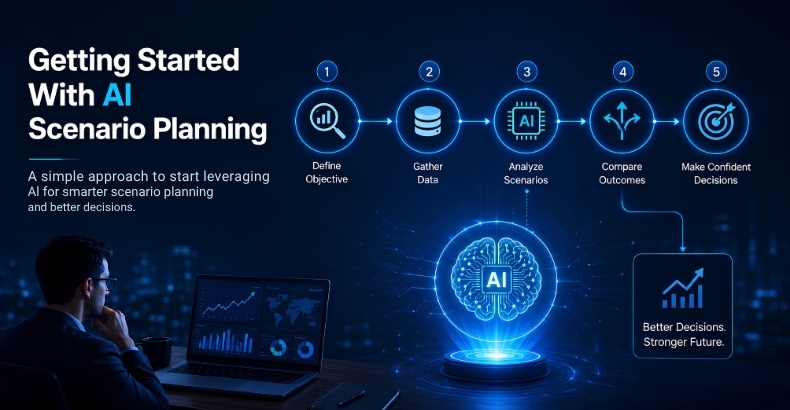
Organizations do not need a highly complex AI system to begin.
A practical starting point is to focus on one important business question, such as the following:
How would a 15% increase in demand affect production capacity, inventory, and delivery timelines?
Teams can then identify relevant data, define key variables, and build a focused scenario model.
A simple approach includes:
- Start with a high-impact business problem.
- Use accurate and relevant data.
- Define realistic assumptions.
- Compare multiple possible outcomes.
- Improve the model as new data becomes available.
Starting small allows organizations to prove value before expanding scenario planning across the business.
From Forecasting to Decision Intelligence
In 2026, the bigger opportunity is moving beyond traditional forecasting toward decision intelligence.
AI can monitor changing conditions, identify emerging risks, and help teams evaluate potential responses. When combined with real-time analytics and AI agents, scenario analysis can become part of everyday decision-making.
Instead of only asking what happened, organizations can explore what may happen next and determine which actions could produce better outcomes.
This creates a more proactive and resilient approach to business planning.
Conclusion
Uncertainty will always be part of business, but organizations now have better tools to prepare for it.
AI-powered scenario analysis helps businesses test assumptions, compare outcomes, identify risks, and make informed decisions before committing valuable resources.
The goal is not to predict one perfect future. It is to prepare for multiple possibilities and respond confidently when conditions change.
The most successful organizations will not necessarily be those that predict the future perfectly. They will be the ones prepared for more than one version of it.
In a world where change is constant, the ability to prepare for what comes next can become a powerful competitive advantage.